What Are Hospital Handrails?
Hospital handrails are wall-mounted support rails. They are designed for patients, elderly people, visitors, and staff who need extra support while walking through corridors or moving inside healthcare spaces.
In hospitals, many people may have weak balance, slow movement, or limited mobility. A continuous handrail gives them something stable to hold. This helps improve walking safety and comfort.
Main Purpose of Hospital Handrails
- Support patients and elderly people while walking
- Help reduce fall risks in corridors
- Provide a stable grip along the wall
- Improve accessibility in healthcare buildings
- Create a safer environment for daily movement
What Are Wall Guards?
Wall guards are protective rails or panels installed on walls. Their main job is to protect the wall surface from impact, scratches, dents, and stains.
Hospital corridors are busy areas. Wheelchairs, hospital beds, carts, trolleys, and medical equipment often move through these spaces. Without protection, walls can be damaged easily. Wall guards help reduce this damage.
Main Purpose of Wall Guards
- Protect walls from wheelchairs and carts
- Reduce scratches and impact damage
- Lower long-term repair costs
- Keep hospital corridors clean and professional
- Improve the durability of interior walls
The Main Difference Between Hospital Handrails and Wall Guards
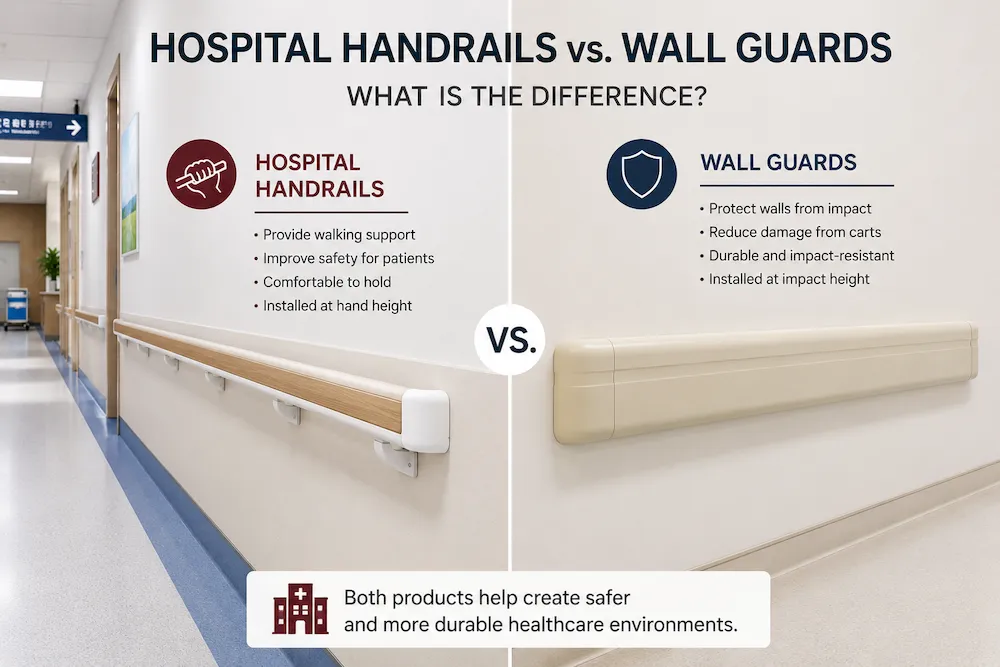
The main difference is simple: hospital handrails support people, while wall guards protect walls.
A handrail is designed to be held by the hand. It must have a comfortable grip, stable structure, and proper installation height. A wall guard is designed to receive impact. It is usually placed at the height where carts, beds, or wheelchairs may hit the wall.
Simple Comparison
- Hospital handrails: for people to hold and walk safely
- Wall guards: for protecting walls from impact
- Handrails: focus on grip, support, and accessibility
- Wall guards: focus on impact resistance and wall protection
- Handrails: often installed at hand height
- Wall guards: often installed at impact height
Where Are Hospital Handrails Used?
Hospital handrails are commonly used in areas where people need support while walking. They are especially important in long corridors and areas used by patients or elderly people.
Common Application Areas
- Hospital corridors
- Nursing home corridors
- Rehabilitation centers
- Clinics and medical centers
- Senior living facilities
- Public healthcare buildings
- Patient care areas
In these places, handrails help people move with more confidence. They also give patients a place to rest their hand when walking slowly.
Where Are Wall Guards Used?
Wall guards are used in areas where walls are easily damaged by traffic and equipment. In hospitals, the walls can be hit many times every day by beds, carts, wheelchairs, and cleaning machines.
Common Application Areas
- Hospital corridors with heavy traffic
- Emergency areas
- Patient transfer routes
- Service corridors
- Storage and equipment areas
- Nursing homes with wheelchair users
- Public buildings with frequent cart movement
Wall guards help protect painted walls, wall panels, and corners from daily damage. This helps the building look cleaner for a longer time.
Can One Product Do Both Jobs?
Yes, some products can provide both walking support and wall protection. These products are often called hospital wall protection handrails, combination handrails, or handrail wall guards.
A combination handrail has a grip area for users and a wider protective body to reduce wall impact. This type of product is very useful in hospital corridors because it solves two problems at the same time.
Benefits of Combination Handrails
- Provide support for patients and elderly users
- Protect walls from light to medium impact
- Save space compared with separate systems
- Create a clean and unified corridor design
- Reduce the number of products installed on the wall
For many healthcare projects, a combination handrail is a practical choice. It is especially useful in corridors where both safety and wall protection are important.
Material Differences
Hospital handrails and wall guards can be made from different materials. The right material depends on the project type, budget, cleaning needs, design style, and expected traffic.
Common Materials for Hospital Handrails
- PVC cover with aluminum inner core
- Aluminum alloy
- Stainless steel
- Nylon-covered metal
- Wood-look or warm-touch materials
Hospital handrails should feel comfortable to hold. They should also be strong, stable, and easy to clean.
Common Materials for Wall Guards
- PVC wall protection strips
- Vinyl wall guards
- High-impact plastic panels
- Rubber or bumper materials
- Aluminum or stainless steel protection rails
Wall guards need good impact resistance. Their surface should be durable and able to handle repeated contact from equipment.
Design and Appearance
Both hospital handrails and wall guards affect the look of a healthcare building. A clean and professional design can make the corridor feel safer and more organized.
Handrails are more visible to users because they are installed at hand height. Their shape, color, and surface finish should match the hospital interior. Wall guards may be simpler, but they still need to match the wall and floor design.
Design Points to Consider
- Color contrast with the wall
- Clean and modern shape
- Comfortable handrail grip
- Easy-to-clean surface
- Matching corner guards and wall panels
- Consistent design across corridors
Installation Height
Hospital handrails and wall guards are usually installed at different heights. This is because they have different functions.
Handrails should be placed at a height that is comfortable for people to hold. Wall guards should be placed at the height where damage is most likely to happen. For example, they may be installed at the height where carts, beds, or wheelchairs hit the wall.
Why Installation Height Matters
- Correct handrail height improves walking support
- Correct wall guard height improves wall protection
- Poor installation can reduce product performance
- Wrong height may make the product difficult to use
- Project drawings should confirm the final height
Cleaning and Maintenance
In healthcare buildings, cleaning is very important. Both hospital handrails and wall guards should be easy to clean and maintain.
Handrails are touched often, so the surface should be smooth and suitable for regular cleaning. Wall guards may collect marks from carts and equipment, so they should be easy to wipe and resistant to stains.
Maintenance Tips
- Choose smooth surfaces with fewer gaps
- Use durable materials for busy areas
- Check brackets and joints regularly
- Replace damaged end caps or sections when needed
- Clean the surface according to supplier instructions
Which One Should You Choose?
The right choice depends on your project needs. If your main goal is to help patients and elderly people walk safely, choose hospital handrails. If your main goal is to protect walls from damage, choose wall guards.
If your corridor needs both walking support and wall protection, choose combination handrails or use both systems together.
Choose Hospital Handrails If You Need:
- Walking support for patients
- Better accessibility
- A safer corridor for elderly users
- A comfortable grip along the wall
- Support in hospitals, nursing homes, and rehabilitation centers
Choose Wall Guards If You Need:
- Wall protection from carts and beds
- Lower wall repair costs
- Better durability in busy corridors
- Protection in service areas and public spaces
- A cleaner and longer-lasting wall finish
Choose Combination Handrails If You Need:
- Both walking support and wall protection
- A clean and unified corridor system
- Better use of wall space
- A practical solution for hospital corridors
- One product system for safety and protection
Questions to Ask Before Ordering
Before choosing hospital handrails or wall guards, it is helpful to prepare your project information. This makes it easier for the supplier to recommend the right product.
Important Questions
- Is the product mainly for walking support or wall protection?
- Where will it be installed?
- What is the wall material?
- How busy is the corridor?
- Will hospital beds, carts, or wheelchairs pass through the area?
- What color or design does the project need?
- Do you need corner guards or wall panels together?
- Do you need custom length or color?
Conclusion
Hospital handrails and wall guards are both useful in healthcare buildings, but they are not the same. Hospital handrails are mainly used to support people while walking. Wall guards are mainly used to protect walls from impact and damage.
In many hospitals, nursing homes, and rehabilitation centers, the best choice is not one product only. A complete corridor safety system may include handrails, wall guards, corner guards, and wall protection panels.
If your project needs safe walking support, choose hospital handrails. If your project needs wall protection, choose wall guards. If you need both, a combination handrail system can be a smart and practical solution.