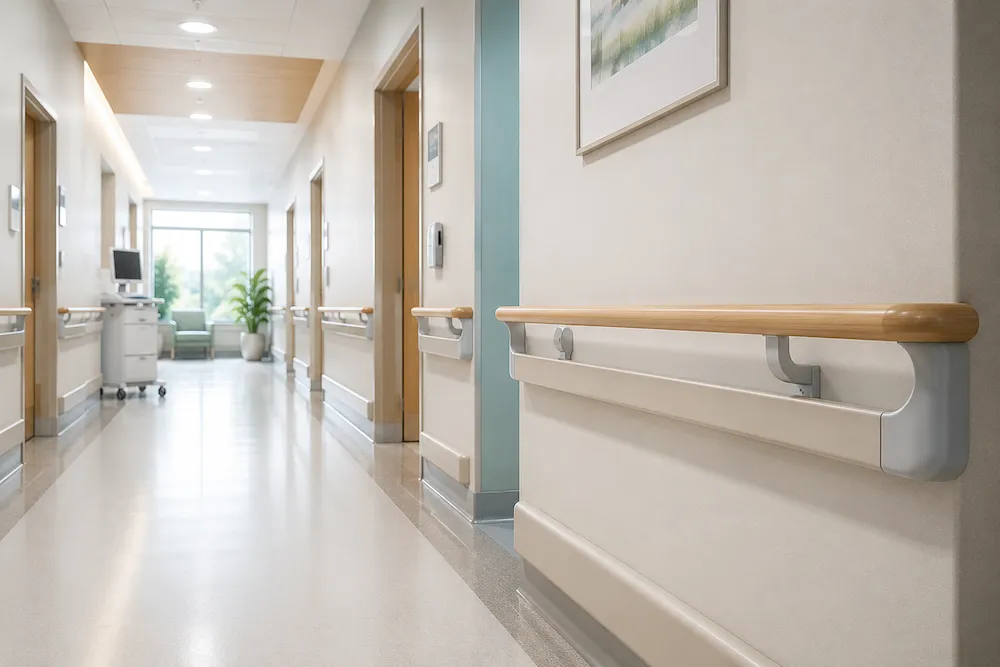
Why Hospital Corridor Handrails Are Important
Hospital corridors are busy areas. Patients may walk slowly, use wheelchairs, hold medical equipment, or need support after surgery. Elderly people may have weak balance. Visitors may also need a safe path when moving through the building.
Corridor handrails provide a continuous support line along the wall. People can hold the rail while walking, standing, or resting. This makes movement safer and easier, especially in long corridors.
Main Benefits of Hospital Handrails
- Help patients and elderly people walk more safely
- Reduce the risk of slips and falls
- Protect corridor walls from impact damage
- Improve the professional look of healthcare spaces
- Support daily use in hospitals, nursing homes, and clinics
Choose the Right Material
Material is one of the most important points when choosing hospital corridor handrails. The material affects strength, cleaning, comfort, appearance, and service life.
PVC Hospital Handrails
PVC hospital handrails are widely used in hospitals and nursing homes. They often have an aluminum alloy inner core and a PVC outer cover. The aluminum core gives strength, while the PVC surface is comfortable to touch and easy to clean.
PVC handrails are also available in many colors. This makes them suitable for different hospital designs. For example, light colors can make a corridor look clean and calm. Stronger colors can help with wayfinding in different hospital areas.
Aluminum Handrails
Aluminum handrails are strong and lightweight. They are often used as the internal support structure of hospital handrails. Some designs may also show the aluminum surface. Aluminum is durable and suitable for long-term use.
Stainless Steel Handrails
Stainless steel handrails are strong, clean, and modern. They are often used in public buildings, bathrooms, and areas that need high durability. However, in hospital corridors, stainless steel may feel colder to the hand than PVC or nylon-covered options.
Check the Strength and Structure
A hospital corridor handrail must be strong enough for daily use. It should support people when they lean on it, hold it, or use it for balance. The handrail should not shake after installation.
When choosing a product, check the internal structure, wall brackets, mounting system, and accessories. A good hospital handrail usually has a strong inner core, stable brackets, and secure end caps.
Important Structure Details
- Strong aluminum or metal inner core
- Stable wall mounting brackets
- Smooth end caps and corner parts
- Good connection between each handrail section
- Impact-resistant outer surface
Consider Wall Protection
In hospitals, corridor walls are often hit by wheelchairs, hospital beds, carts, and medical equipment. A normal handrail only provides support for walking. A hospital wall protection handrail can provide both support and wall protection.
Some handrails are designed with a wider profile. They can act like a wall guard and reduce damage caused by impact. This is useful in busy hospital corridors, nursing homes, and rehabilitation centers.
When You Need Wall Protection Handrails
- Busy hospital corridors
- Areas with hospital beds and medical carts
- Nursing homes with wheelchair users
- Rehabilitation centers with high patient movement
- Public healthcare buildings with heavy traffic
Choose a Comfortable Grip Design
A hospital handrail should be easy and comfortable to hold. The surface should not be too sharp, too slippery, or too large for the hand. Patients and elderly people need a handrail that feels safe and natural.
The shape should allow users to grip the handrail easily. Rounded edges are better than sharp edges. A smooth but non-slippery surface can improve user comfort.
Good Grip Design Features
- Rounded and smooth edges
- Comfortable hand size
- Easy-to-clean surface
- Not too cold to touch
- Stable support when walking
Think About Hygiene and Cleaning
Hygiene is very important in healthcare environments. Hospital corridor handrails are touched many times every day. They should be easy to clean and suitable for regular disinfection.
Choose handrails with smooth surfaces and simple shapes. Avoid designs with too many gaps or hard-to-clean corners. Some products may also use antibacterial or antimicrobial materials, which can be helpful in medical spaces.
Cleaning-Friendly Features
- Smooth surface
- Few gaps and joints
- Easy-to-wipe material
- Good resistance to common cleaning agents
- Durable color and surface finish
Select Suitable Colors
Color is not only about design. In healthcare buildings, color can also help with wayfinding and safety. A clear color contrast between the handrail and the wall can make the handrail easier to see.
For hospitals, soft and clean colors are common. For nursing homes, warmer colors may create a more comfortable feeling. For special areas, different colors can help people identify different departments or floors.
Common Color Ideas
- White or light gray for a clean medical look
- Wood grain for a warmer nursing home style
- Blue or green for calm healthcare spaces
- High-contrast colors for better visibility
- Custom colors for hospital branding or wayfinding
Plan the Installation Carefully
Even a good handrail will not work well if it is not installed correctly. Before installation, check the wall type, corridor width, mounting height, and bracket spacing. The wall must be strong enough to hold the handrail securely.
In many projects, installation should be planned together with the building design, wall finish, and other wall protection products. This helps avoid problems during construction.
Installation Points to Check
- Wall material and wall strength
- Recommended handrail height
- Bracket spacing
- Corner connections
- End caps and return ends
- Distance from doors, equipment, and other wall items
Match Handrails with Other Wall Protection Products
Hospital corridors often need more than handrails. They may also need wall guards, corner guards, crash rails, and wall panels. These products work together to protect the building and improve safety.
If your project has heavy traffic, it is better to think about the whole wall protection system, not only the handrail. A complete system can make the corridor more durable and easier to maintain.
Related Products to Consider
- Wall guards
- Crash rails
- Corner guards
- Wall protection panels
- Door protection plates
- Bathroom grab bars
Consider Long-Term Maintenance
Hospital products should be made for long-term use. A low-cost handrail may look good at first, but it may become loose, faded, cracked, or hard to clean after some time. This can increase maintenance costs.
Choose handrails with durable materials, replaceable parts, and reliable accessories. It is also helpful to choose a supplier that can provide spare parts, installation guidance, and product support.
Maintenance Questions to Ask
- Can the surface be cleaned easily?
- Are the end caps and brackets replaceable?
- Will the color stay stable over time?
- Can damaged sections be replaced?
- Does the supplier provide technical support?
Choose a Reliable Supplier
A reliable supplier can help you choose the right product for your project. They should understand hospital corridors, nursing homes, rehabilitation centers, and accessibility needs.
Before ordering, ask for product photos, material details, color options, size information, installation instructions, and packaging details. If possible, request samples to check the quality before placing a large order.
What a Good Supplier Should Provide
- Clear product specifications
- Material and structure information
- Color options
- Installation guidance
- Sample support
- Custom size or color options
- Fast quotation and communication
Conclusion
Choosing hospital corridor handrails requires more than selecting a simple wall-mounted rail. You need to consider safety, comfort, wall protection, material, cleaning, installation, color, and maintenance.
For hospitals, nursing homes, rehabilitation centers, and public healthcare buildings, the right handrail system can improve safety and protect the building at the same time. A strong, easy-to-clean, comfortable, and well-installed handrail is a practical investment for any healthcare facility.
If you are planning a healthcare handrail project, prepare your corridor drawings, product requirements, quantity, color preference, and installation details. This will help your supplier recommend the most suitable hospital corridor handrail solution.